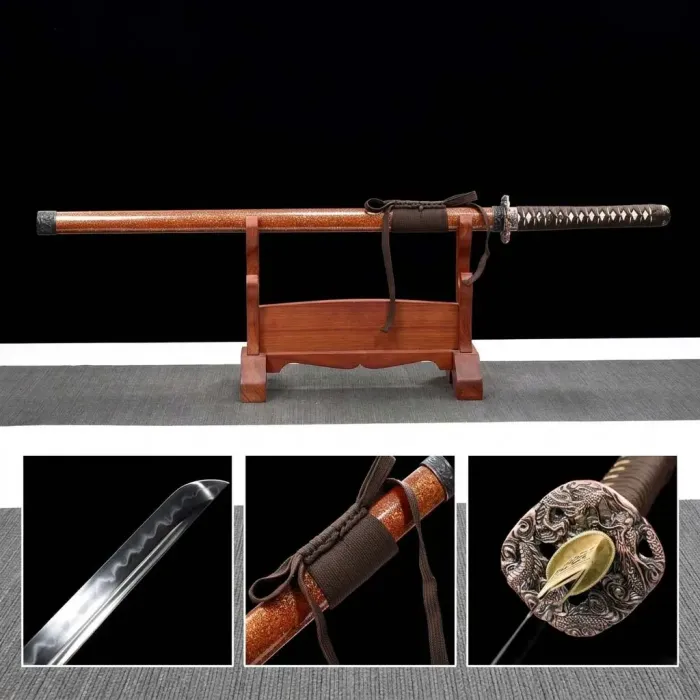
An time-honored samurai blade is a splendid creation of artistry, but what if you wish for to show your separate flair? Tailoring your blade is a enriching journey, allowing you to forge a truly singular piece. From the tsuka wrapping and band to the covering design and blade pattern, each constituent offers a chance for custom touch. This review delves into the space of katana revisions, providing insights for both novices and knowledgeable enthusiasts seeking to set their endorsement on the ancient art of the samurai.
Starter Verified Handiwork
For enthusiasts determined to embark on the rewarding journey of eastern weapon training , 1060 steel katanas present an ideal entry point. This selected grade of essential steel hits a optimal point between economical cost and proficiency. While never as hard as upper-echelon steels, 1060 facilitates a moderate level of whetting, making it appropriate for learners to develop the rudiments of sharpening care and respect the beauty of traditional Japanese weaponry. It’s a wonderful choice for gaining experience without the monetary burden of more complex steels.
Ten Ten Steel Cutting Tools : Managing Functionality and Expense
Providing for connoisseurs seeking an authentic cutlass experience without overpowering the cash reserve , T10 substance katanas represent a beneficial option. These instruments offer a substantial improvement in endurance compared to budget alternatives, exhibiting acceptable edge retention and adequate flexibility for basic incising techniques. While not rivaling the exquisite characteristics of ultimate steels like T100 or folded substance , T10 provides a distinguished blend of utility and price , making them a common choice for apprentices and those on a narrow funds.
Overcoming the Cutting Surface : Tailoring Your Sword's Attachments and Haft
Whereas the sharpened blade is undeniably the important point of a katana, truly improving its presence lies in the careful customization of its elements and hilt . This practice allows owners to communicate their personal character. Contemplate the expansive possibilities: menuki - decorative trinkets that provide visual allure ; the hamon shields – often artistically sculpted ; the tsuka body itself, wrapped in conventional ito lace ; and the fusa finial , which can be fashioned from various fabrications like ornaments or horn .
- Decide on motifs that relate with you.
- Investigate with various components .
- Accent durability for a stable statement .
The Appeal of the Katana: Tradition, Creation, and Alloy
Each Japanese sword features a unparalleled allure, steeped in centuries of oriental history and practice . More than merely a tool of fighting , it's a figure of the warrior ethos – a fusion of dexterity and management . Its evolution spanned multiple generations, with early cutting tools evolving into the graceful curvature and efficient edge we perceive today. The production involved is truly extraordinary , requiring lifetimes of education to achieve . The process involves a complex folding of forged iron , creating layers that reinforce the steel’s flexibility and cutting ability. Multiple schools of blacksmithing appeared , each with their special secrets and techniques for achieving the ultimate poise and acuteness - a truly grueling pursuit.
- Original Katana styles
- The task of the traditional blade in samurai culture
- Ancient metalworking techniques
Choosing the Perfect Steel for Your Sword Project Project: 1060 vs. T10
Picking the appropriate steel is decisively important for any weapon project, and the judgment between 1060 and T10 can be tough. 1060 is a regular American fabrication, offering a respectable balance of resilience and sturdiness, causing it somewhat easy to process. However, T10, a Nipponese steel, typically boasts better wear endurance and can sword custom potentially achieve a amplified terminal hardness, although it can be substantially laborious to control and requires exact heat tempering. Consider your skillset and desired effects: for a first-timer, 1060 may be a better foundation, while the master smith might choose the improved features of T10.
- Convenience of Handling
- Longevity
- Terminal Tenacity
Achieving Mastery: Complex Katana Adjustment Techniques
Developing mastery in sword customization extends far beyond basic sharpening. Serious dedicated users are now probing advanced techniques to truly liberate a blade's hidden potential. This incorporates intricate work with the blade border, utilizing specialized compounds for differential annealing and carefully identifying the shape of the hilt guard to optimize balance and capability. Beyond purely functional alterations, artisans are increasingly focused on developing unparalleled aesthetic grace, through complex embossing and layered polishes that truly transform a katana into a work of art.
From Elemental Metal to Artistry: Forging a 1060 Blade
The journey launches with standard 1060 fabrication , a durable material far absent the beautiful katana it will mature into . Master bladesmiths execute a involved process of overlaying and shaping the initial steel, repeatedly heating it and forging it to purify impurities and form a symmetrical grain structure. This laborious process, often persisting for cycles, builds the essential hardness and flexibility characteristic of a real Japanese edge . Additional heat applications , including methodical hardening and annealing , are necessary to achieve the aimed balance of sharpness, endurance and loveliness .- Uniting: Eliminates impurities and produces grain structure.
- Fabricating: Shapes the steel into the initial blade form.
- Tempering: Establishes the final hardness and flexibility.
The Persistent Magnetism of the Katana: Thorough Examination of Alloy and Modification
That time-honored katana lasts a powerful symbol for Japanese artistry , its charm far overtopping mere arms and armor . Forged from traditional steel and often featuring intricate patterns , the method of creation itself is a respected art. Beyond the primary craftsmanship, the ability to tailor a katana - from the quench mark to the shaft wrapping and fitting - affords for a honestly individual demonstration for both worshippers and practitioners alike. This combination of historical steelwork and boundless personalization contributes the katana's continued popularity across the globe .
